How Much to Feed a Dog by Weight
Quick answer. How much to feed a dog comes down to body weight, age, and the food in the bowl. The chart below is a starting point for a neutered adult on dry food. The calculator uses the same formula as PupPlan, based on AAHA 2021. Then let body condition tell you whether to adjust.
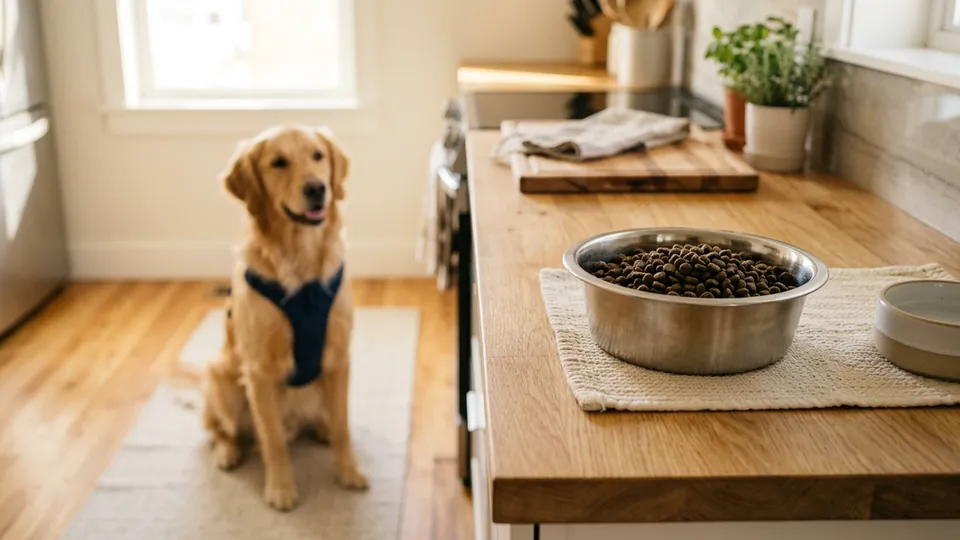
How much should you feed a dog by weight?
These daily amounts are for neutered adult dogs eating dry food at about 3,500 kcal per kg. Low activity is resting energy × 1.4, moderate is × 1.6, and high activity is × 2.0. Grams are rounded to the nearest 5. They are a starting point, not a prescription: feed for the weight your dog should be, then adjust from body condition.
| Body weight | Low activity | Moderate | High activity |
|---|---|---|---|
| 2 kg (4.4 lb) | 45 g · 165 kcal | 55 g · 188 kcal | 65 g · 235 kcal |
| 5 kg (11 lb) | 95 g · 328 kcal | 105 g · 374 kcal | 135 g · 468 kcal |
| 10 kg (22 lb) | 155 g · 551 kcal | 180 g · 630 kcal | 225 g · 787 kcal |
| 15 kg (33 lb) | 215 g · 747 kcal | 245 g · 854 kcal | 305 g · 1,067 kcal |
| 20 kg (44 lb) | 265 g · 927 kcal | 305 g · 1,059 kcal | 380 g · 1,324 kcal |
| 25 kg (55 lb) | 315 g · 1,096 kcal | 360 g · 1,252 kcal | 445 g · 1,565 kcal |
| 30 kg (66 lb) | 360 g · 1,256 kcal | 410 g · 1,436 kcal | 515 g · 1,795 kcal |
| 40 kg (88 lb) | 445 g · 1,559 kcal | 510 g · 1,781 kcal | 635 g · 2,227 kcal |
| 50 kg (110 lb) | 525 g · 1,843 kcal | 600 g · 2,106 kcal | 750 g · 2,632 kcal |
What percentage of body weight should you feed?
A rule of thumb you will see a lot: feed an adult dog about 2–3% of body weight a day. For a 10 kg dog that is 200–300 g, and for a 20 kg dog it is 400–600 g. Call it approximate. It ignores calorie density and life stage, and on a 3,500 kcal/kg kibble it usually sits higher than the moderate column in the table, especially for heavier dogs. Use it as a quick sense-check, then go back to calories and body condition.
How much to feed a small dog
Small dogs need fewer grams per day and more grams per kilogram than large dogs, because energy needs do not scale in a straight line. At the neutered-adult moderate factor (× 1.6) and 3,500 kcal per kg, a 5 kg dog needs about 107 g a day (about 374 kcal), around 21 g per kilogram of body weight. A 30 kg dog needs about 410 g (about 1,436 kcal), around 14 g per kilogram. An extra 20 g is a much bigger share of the small dog's day, so weigh the food and subtract training treats from the meals.
How much kibble should I feed my dog
Kibble portions follow the calories on your bag, not a universal cup. Grams per day = daily kcal ÷ kcal per kg × 1,000. A 20 kg neutered adult at moderate activity (× 1.6) needs about 1,059 kcal, which is about 303 g of a 3,500 kcal/kg food. Cups are a volume. If that same bag says 400 kcal per cup, the cup count is about 2.6 cups, and that is only true for that food. When the bag gives kcal per kg and not per cup, this page estimates cups at about 120 g per cup. Kibble size changes that weight, so weigh one cup of yours before you trust a cup measure. Comparing foods by the scoop, instead of by kcal, is how portions drift.
Feeding calculator
Enter a weight, an age, and the energy figure printed on your bag. Activity, neuter status, and expected adult size choose the factor. The result is a starting portion, and it is the same formula PupPlan uses, based on AAHA 2021. Body condition over the next few weeks decides whether to change it. PupPlan tracks what you actually feed: the button under the calculator opens the app.
How this is calculated
Resting energy (RER) is 70 × body weight in kilograms, raised to the power 0.75. Daily energy (DER) is that RER multiplied by one factor. There is no extra breed-size multiplier. Pounds convert at × 0.45359237. The factors are the ones PupPlan uses, based on AAHA 2021, and each result is a single number.
A puppy is younger than its expected adult size: 12 months at 25 kg or under, or if the size is unknown; 18 months over 25 kg up to 45 kg; 24 months over 45 kg. Under 4 months the factor is 3.0, then 2.0 until that age. Activity, neuter status, and a weight-loss goal do not change a puppy factor. A neutered adult is × 1.4 low, × 1.6 moderate, × 2.0 high, and × 3.0 working. Intact is 0.2 higher, and not sure counts as neutered. An adult weight-loss goal uses × 1.0. Seniors start at 7 years under 15 kg expected adult size, otherwise at 8 years: × 1.2, × 1.4, × 1.6, and × 2.0. Neuter status and weight loss do not change a senior factor. Meals are four a day under 3 months, three from 3 to under 6 months, and two from 6 months on.
Daily calories are the DER rounded to a whole number. Calories per meal divide the unrounded DER by the meals, then round. Treats are 10% of the rounded daily calories, taken out of the meals. Grams equal daily kcal divided by kcal per kg, times 1,000, to one decimal. Cups equal daily kcal divided by kcal per cup. This page uses about 120 g per cup only when the bag gives kcal per kg and not per cup.
| Situation | Factor (× RER) |
|---|---|
| Puppy, under 4 months | × 3.0 |
| Puppy, 4 months until adult size | × 2.0 |
| Neutered adult, low | × 1.4 |
| Neutered adult, moderate | × 1.6 |
| Neutered adult, high | × 2.0 |
| Neutered adult, working | × 3.0 |
| Intact adult | 0.2 higher |
| Senior, low | × 1.2 |
| Senior, moderate | × 1.4 |
| Senior, high | × 1.6 |
| Senior, working | × 2.0 |
| Adult weight-loss goal | × 1.0 |
Your estimate
- Resting energy (RER)
- Daily calories (DER)
- Amount per day
- Per meal
This is a starting estimate: adjust it for body condition, and ask your vet before a weight-loss plan, a growth plan for a puppy, or any medical diet.
PupPlan tracks feeding
Log each meal and your dog's weight in PupPlan. The app tracks feeding and keeps a daily calorie target from the same formula as this page, next to what you actually fed, so you can adjust the portion as body condition changes.


Puppies
Puppies need more calories per kilogram than adults. Under 4 months the factor is resting energy × 3.0. From 4 months until adult size it is × 2.0. Adult size is 12 months when the expected adult weight is 25 kg or less, or unknown; 18 months when it is over 25 kg up to 45 kg; and 24 months when it is over 45 kg. Meals are four a day under 3 months, three from 3 to under 6 months, and two from 6 months on. Activity, neuter status, and a weight-loss goal do not change the puppy factor. Use a complete puppy food matched to the expected adult size, and check growth and portions with your vet, especially for large breeds. The chart higher up is for neutered adults, not for puppies.
Adult dogs
Most adult dogs do well on two meals a day. A neutered adult is × 1.4 at low activity, × 1.6 at moderate, × 2.0 at high, and × 3.0 if the dog works. An intact adult is 0.2 higher on each of those. Not sure is treated as neutered. An adult whose goal is weight loss uses × 1.0, and that plan should be agreed with your vet. Feed the ideal weight, not the current weight, if your dog is already carrying extra.
Senior dogs
A small dog, expected adult weight under 15 kg, is treated as senior from 7 years. Other dogs, and any dog whose adult size is unknown, are senior from 8 years. Senior factors are × 1.2 at low activity, × 1.4 at moderate, × 1.6 at high, and × 2.0 if the dog is still working. Neuter status and a weight-loss goal do not change that factor. It is easy to keep the adult portion after the walks get shorter. Recheck ribs, waist, and tummy tuck every couple of weeks and lower the food if the waist disappears. Illness, a sudden appetite change, or a diet your vet prescribed is not a job for this chart.
Why There's No Single Answer
Two dogs of the same breed and weight can need very different amounts of food. How much your dog should eat depends on a stack of factors that all pull in different directions:
- Body weight — bigger dogs need more, but not in a straight line (a dog twice the weight doesn't need twice the calories).
- Age and life stage — growing puppies and active young adults burn far more than settled seniors.
- Neuter status — neutered and spayed dogs typically need fewer calories, so they gain weight easily on the same portion.
- Activity level — a working sheepdog and a flat-dwelling companion of equal size live in different worlds.
- Metabolism — like people, some dogs simply run hot or cold.
- The food itself — calorie density varies enormously between brands and between dry, wet, and raw diets.
Because of that last point especially, a "cup of food" means nothing on its own. The same cup can hold wildly different amounts of energy depending on the recipe. So the goal isn't to copy a number from a friend — it's to find the right amount for the dog in front of you.
Start With the Food Label
Every complete dog food carries a feeding guide — a table matching body weight to a daily amount. It's the best starting point you have, but treat it as exactly that: a starting point, not a prescription.
Two things are worth knowing about these charts. First, the amounts are often generous; manufacturers would rather you feed a little too much than have a hungry, dissatisfied dog. Many dogs do well on somewhat less than the chart suggests. Second, the figures are based on your dog's ideal body weight, not the current weight. If your dog is already overweight, feeding for the current number only locks in the problem — feed for the weight your dog should be.
Tip: Always read the calories (kcal) per 100g or per cup on the packaging. It's the only fair way to compare foods and the figure that actually drives your dog's weight — far more reliable than the size of the scoop.
Body Condition Score Beats Any Formula
No chart or calculator knows your dog. Your hands and eyes do. The most reliable way vets and breeders judge whether a dog is the right weight is the body condition score, usually on a 1–9 scale where around 4–5 is ideal. You can check it at home in under a minute:
- Ribs — run your hands along the chest. You should feel the ribs easily under a thin layer of fat, without having to press. If you can't find them, there's too much covering; if they're sharply visible, too little.
- Waist from above — look down at your standing dog. You should see the body narrow behind the ribcage into a clear waist. A straight or bulging outline means extra weight.
- Tummy tuck from the side — viewed from the side, the belly should rise up behind the ribcage rather than hang level or sag.
Score your dog roughly as under-ideal, ideal, or over-ideal. A dog that's a little ribby with a deep tuck may need more food; a dog with no waist and hidden ribs needs less. Recheck every couple of weeks — it changes slowly, so you're watching a trend, not a single reading. Breeds with thick or long coats can hide a lot, so trust your hands over a quick glance.
How often should you feed a dog?
Once you know the total daily amount, split it sensibly across the day:
- Puppies — four meals a day under 3 months, three from 3 to under 6 months, and two from 6 months on, even while they are still growing.
- Adults — one or two meals a day. Twice daily suits most dogs, keeping energy steady and the stomach comfortable.
Whatever rhythm you pick, keep it consistent — the same meals at roughly the same times help digestion and make house-training and routine far easier. And measure properly. A scoop or a "handful" drifts over time, and that drift is how dogs quietly gain weight. A cheap kitchen scale is more accurate than a measuring cup, and weighing food takes seconds once it's a habit.
Treats, Chews & the 10% Rule
Treats count. It's easy to feed a careful, measured meal and then undo it with chews, scraps, and training rewards across the day. The widely used rule of thumb: treats should make up no more than 10% of your dog's daily calories, with the rest coming from a complete, balanced food. What is safe as a treat, and what is not, is in what dogs can and can't eat.
If you're doing a lot of training, don't simply add those treats on top — subtract them from the meals so the daily total stays the same. A few practical habits help:
- Use tiny, pea-sized treats; for most rewards, dogs care about the count, not the size.
- Reach for low-calorie options — a piece of their own kibble, or dog-safe veg like carrot or green beans.
- Account for dental chews and long-lasting chews; some carry surprising calories.
Adjusting Over Time
Feeding the right amount isn't a one-off calculation — it's a habit of checking and tweaking. Weigh your dog regularly and reassess body condition every few weeks. If your dog is drifting heavier or lighter than ideal, adjust the daily food by around 10% and then wait two to four weeks before judging the result. Small, patient changes beat dramatic swings.
Needs also shift with life: a neuter, a quieter winter, an injury, or simply getting older can all lower the right amount, while a growth spurt or a more active season raises it. Keep watching the trend rather than reacting to a single weigh-in.
Finally, know when this stops being a DIY job. Ongoing weight problems, a sudden change in appetite or weight, or any prescribed weight-loss, puppy-growth, or medical diet should go through your vet. If the bowl is coming back full, my dog won't eat covers the usual causes. A formula or an app can set the portion, but only your vet can rule out the health issues that sometimes hide behind a changing waistline.
Common Mistakes
- Treating the bag's chart as gospel. It's a generous, average starting point — adjust to the dog, not the table.
- Feeding for current weight, not ideal weight. If your dog is overweight, this just maintains the problem.
- Eyeballing portions. Scoops and handfuls creep upward; weigh the food.
- Forgetting treats and chews. They can quietly account for far more than 10% of the day's calories.
- Comparing foods by volume. A cup of one food can hold twice the calories of another — compare kcal, not scoops.
- Changing too much, too fast. Adjust by about 10% and reassess in a few weeks rather than slashing portions overnight.
Frequently Asked Questions
How much should I feed my dog by weight?
Use the chart: at about 3,500 kcal per kg, a neutered adult at moderate activity needs about 180 g a day at 10 kg (630 kcal), about 303 g at 20 kg (1,059 kcal), and about 410 g at 30 kg (1,436 kcal). The chart also shows low and high activity, with grams rounded to the nearest 5. Then adjust from body condition, and use the calculator if your food is not 3,500 kcal per kg.
How much should I feed a small dog?
Less in total, more per kilogram. A 5 kg neutered adult at moderate activity on a 3,500 kcal/kg food needs about 107 g a day (about 374 kcal). Weigh it. Treats count toward that total.
How much kibble should I feed my dog?
Read kcal per kg or per cup on the bag. Grams = daily kcal ÷ kcal per kg × 1,000. A cup is not a fixed weight: use the kcal-per-cup figure only for that kibble. The calculator estimates cups at 120 g only when the bag gives kcal per kg and not per cup.
Should I feed my dog once or twice a day?
Twice a day suits most adult dogs — it keeps energy steady and is gentler on the stomach than one big meal. Puppies under 3 months need four meals, puppies from 3 to under 6 months need three, and from 6 months the calculator uses two. Whichever you choose, keep the number of meals and the total amount consistent; routine matters more than the exact schedule.
How do I know if my dog is overweight?
Check the body condition score: you should feel the ribs easily under a thin layer of fat, see a clear waist from above, and see the belly tuck up from the side. If the ribs are hard to find and the waist has gone, your dog is likely overweight — ask your vet to confirm and advise.
Can I just follow the feeding guide on the bag?
Use it as a starting point. The amounts are population averages and often generous, so many dogs need less, and they assume your dog's ideal weight rather than the current one. Begin near the chart, then adjust up or down based on body condition.
How much should I feed a puppy?
Puppies need more calories per kilogram than adults. The factor is × 3.0 under 4 months and × 2.0 from 4 months until adult size: 12 months at 25 kg or under (or if you do not know), 18 months over 25 kg up to 45 kg, and 24 months over 45 kg. Meals are four a day under 3 months, three from 3 to under 6 months, and two after that. Confirm growth and portions with your vet, especially for large breeds.
Puppy feeding also belongs with a puppy's first weeks and the vaccination schedule.
Sources
This guide follows published guidance from the organisations named below. Your own vet knows this dog; use these pages as background, not as a diagnosis or a timetable.